• Welcome to your new Gnomio site

    Now, you are in control!

    Moodle is an open-source Learning Management System (LMS) that provides educators with the tools and features to create and manage online courses. It allows educators to organize course materials, create quizzes and assignments, host discussion forums, and track student progress. Moodle is highly flexible and can be customized to meet the specific needs of different institutions and learning environments.

    Moodle supports both synchronous and asynchronous learning environments, enabling educators to host live webinars, video conferences, and chat sessions, as well as providing a variety of tools that support self-paced learning, including videos, interactive quizzes, and discussion forums. The platform also integrates with other tools and systems, such as Google Apps and plagiarism detection software, to provide a seamless learning experience.

    Moodle is widely used in educational institutions, including universities, K-12 schools, and corporate training programs. It is well-suited to online and blended learning environments and distance education programs. Additionally, Moodle's accessibility features make it a popular choice for learners with disabilities, ensuring that courses are inclusive and accessible to all learners.

    The Moodle community is an active group of users, developers, and educators who contribute to the platform's development and improvement. The community provides support, resources, and documentation for users, as well as a forum for sharing ideas and best practices. Moodle releases regular updates and improvements, ensuring that the platform remains up-to-date with the latest technologies and best practices.

    Links of interest:

    (You can edit or remove this text)

Available courses

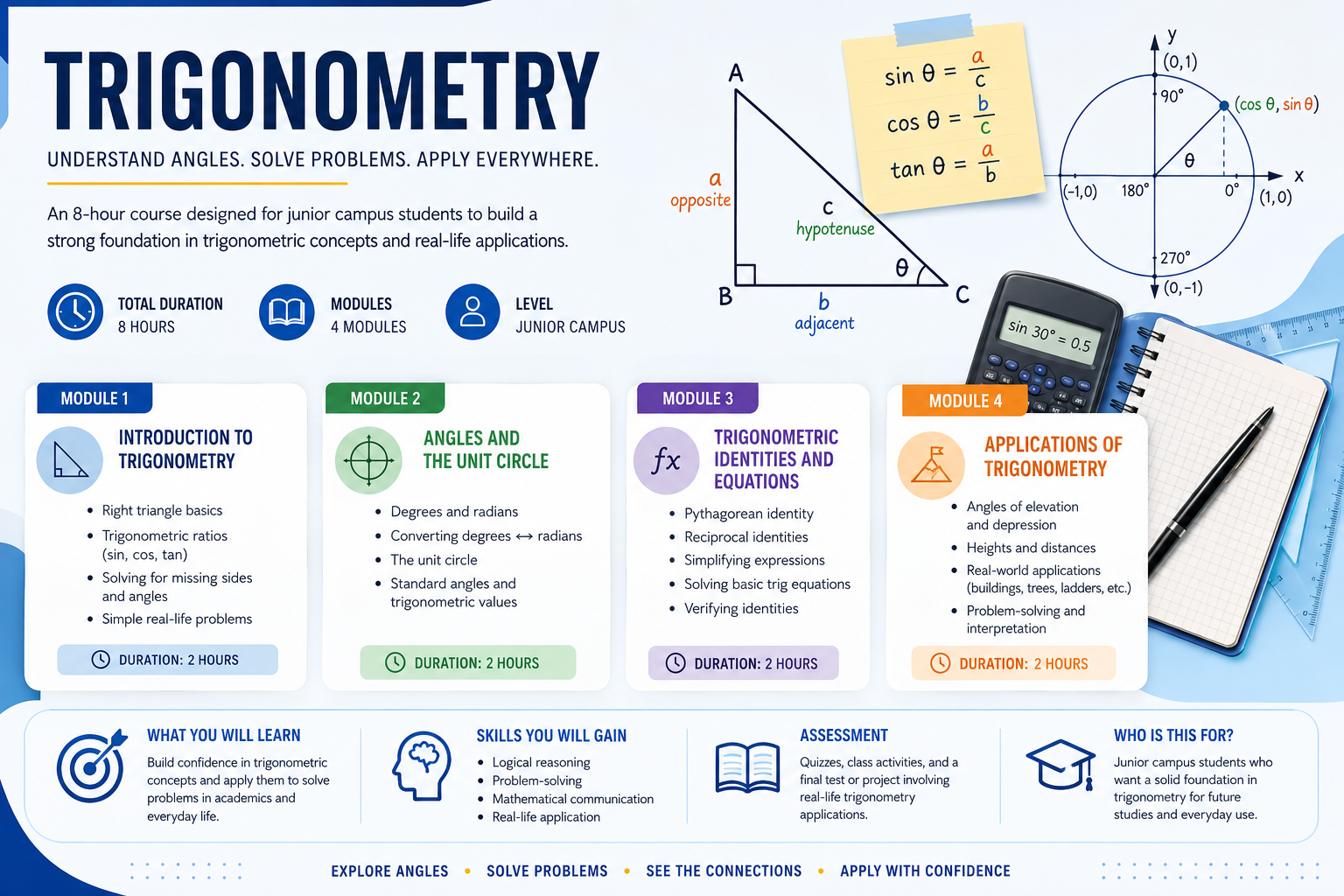
This course introduces Valley Technical Training Institute trainees to the fundamental concepts of trigonometry and their practical applications. Students begin by understanding the relationship between angles and sides in right-angled triangles and learn how to use the basic trigonometric ratios—sine, cosine, and tangent—to solve problems involving unknown sides and angles.

The course then explores angle measurement in degrees and radians and introduces the unit circle as a tool for understanding trigonometric functions and their values at standard angles. Students develop skills in converting between degrees and radians and interpreting coordinates on the unit circle.

Building on these foundations, students learn basic trigonometric identities and equations, including the Pythagorean identity and reciprocal relationships. They practice simplifying trigonometric expressions and solving simple trigonometric equations.

Finally, the course emphasizes real-world applications of trigonometry, including determining heights, distances, and angles of elevation and depression. Through practical examples and problem-solving activities, students gain confidence in applying trigonometric concepts to everyday situations and further mathematical studies.

Overall Course Learning Outcomes

By the end of the course, students should be able to:

  1. Explain fundamental trigonometric concepts and terminology.
  2. Use sine, cosine, and tangent ratios to solve right-triangle problems.
  3. Convert between degrees and radians and use the unit circle to determine trigonometric values.
  4. Apply basic trigonometric identities and solve simple trigonometric equations.
  5. Use trigonometry to solve practical problems involving heights, distances, and angles.
  6. Demonstrate logical reasoning and mathematical communication when solving trigonometric problems.

Introduction to Algebra

Course Overview

Introduction to Algebra is a foundational mathematics course designed to develop learners’ understanding of algebraic concepts, including variables, expressions, equations, and algebraic operations. The course emphasizes problem-solving, logical reasoning, and the ability to apply algebra to real-life situations. It provides a strong foundation for advanced studies in mathematics, science, engineering, and business.


Learning Outcomes

By the end of this course, learners will be able to:

  • Define and correctly use algebraic terminology such as variables, constants, coefficients, terms, and expressions.

  • Formulate and simplify algebraic expressions.

  • Evaluate algebraic expressions by substituting given values.

  • Solve linear equations and basic inequalities.

  • Translate word problems into algebraic equations and interpret solutions.

  • Apply algebraic reasoning to everyday situations and practical problems.


Core Topics


Sample Interactive Learning Activities

  • Algebra Matching Game: Match verbal statements with their algebraic expressions.

  • Think–Pair–Share: Solve equations individually, discuss with a partner, and present solutions.

  • Real-Life Problem Modeling: Convert scenarios like shopping, travel, or work problems into algebraic equations.

  • Group Problem-Solving Challenges: Teams simplify expressions or solve equations competitively.

  • Algebra Relay Race: Sequential team activity solving steps of multi-stage equations on the board.

  • Error Analysis Exercises: Identify and correct mistakes in worked examples.

  • Peer Teaching: Students explain solutions to classmates to reinforce understanding.

  • Quick Quizzes or Exit Tickets: Short questions at the end of lessons to assess comprehension.